
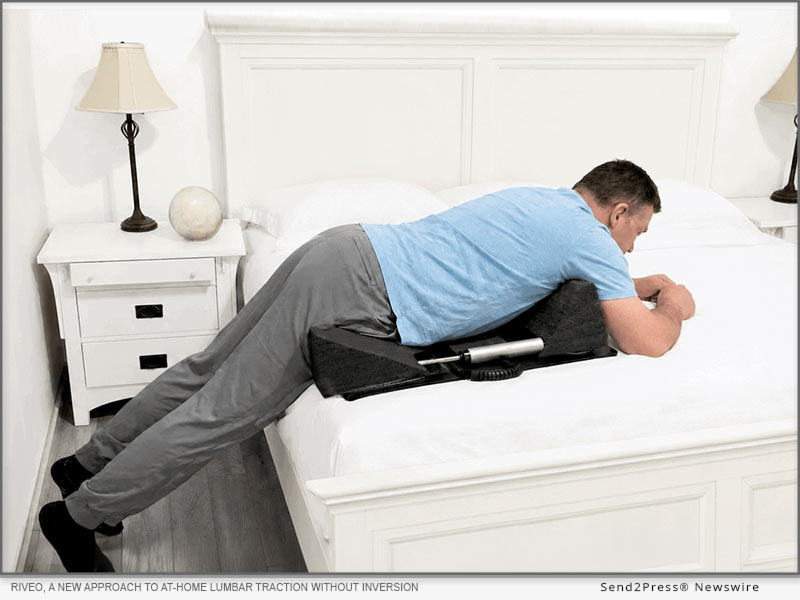
Developed by chiropractor and inventor Dr. James Pamplin, the bed-based device is designed to make lumbar traction at home simpler and more comfortable without hanging upside down, ankle restraints or complicated harness systems
PLYMOUTH, N.H. /CitizenWire/ -- After years of working with patients with lower back problems, New Hampshire chiropractor Dr. James Pamplin saw a practical challenge: people looking for a way to apply traction at home often encounter inversion tables, uncomfortable restraints, or bulky and cumbersome equipment. That challenge ultimately led Pamplin to develop Riveo, a new home lumbar traction device designed to provide a simpler and more comfortable way to apply controlled traction to the lower back.
Unlike an inversion table, where a user is suspended upside down by the feet, Riveo is used with the user's hips and legs positioned off the edge of a bed or similar support surface. Riveo's contoured thigh, chest and shoulder supports create a comfortable body position, while a pneumatic hand pump is used to apply gentle, controlled traction to the lumbar spine.
"The idea behind Riveo was to simplify the entire process of home traction," said Pamplin, founder and inventor of Riveo. "I wanted to develop a way for my patients to apply lumbar traction at home without hanging upside down, using uncomfortable restraints, or dedicating floor area for bulky equipment."
RETHINKING HOW LUMBAR TRACTION CAN BE PERFORMED AT HOME
Lumbar traction is a technique that applies a pulling force along the lumbar spine. In clinical environments, traction may be performed using specialized tables, machines and other professional equipment.
Bringing traction into the home involves many practical considerations.
Inversion tables are among the most recognizable home traction products. They typically secure the user at the ankles and rotate the body backward so gravity creates traction while the person is partially or fully inverted. Other home traction systems can rely on belts, straps or harnesses to apply force.
Pamplin believed there was room for another approach.
Rather than attempting to reproduce a clinical traction table in the home, Riveo was developed around a simpler approach: use the edge of a bed as part of the traction mechanics.
The device supports the thighs while the user remains face down, with the legs extending off the bed's edge. This positioning uses the edge of the support surface and the user's body position to provide counterforce as the device applies controlled traction to the lumbar spine.
"One of my priorities was making the device approachable," Pamplin said. "A home device needs to be practical in any home. That means considering not only how traction is applied, but how easily someone can use the device and store it afterward."
FROM CLINICAL EXPERIENCE TO A PHYSICAL PRODUCT
Pamplin's background as a chiropractor played a central role in Riveo's development.
Years spent working with the mechanics of the lower back and the practical challenges of applying therapeutic techniques outside a clinical environment led him to explore how a simpler home traction device might work.
Developing Riveo required translating the concept of bed-edge traction into a physical device that could position and support the body consistently.
Pamplin experimented with the geometry, physics, pneumatics, body types and support surfaces of the device, refining the concept through multiple iterations before arriving at the current Riveo design.
The end result is a home traction device designed to address some of the practical limitations associated with full-size inversion tables and harness-based traction systems.
"As a chiropractor, I've spent a great deal of time thinking about the mechanics of the lower back and the challenge of supporting care outside of a clinical setting," Pamplin said. "Riveo grew out of the question of whether lumbar traction at home could be better."
DESIGNED AROUND REAL-WORLD HOME USE
Making traction practical at home required considering more than the mechanics of the device.
Full-size inversion tables can require significant floor space and may need to be folded or moved between uses. Some other traction products involve multiple components, straps or specific setup procedures.
Riveo was designed to eliminate those barriers.
The device weighs approximately 17 pounds, occupies about 2 square feet, requires no installation and arrives ready to use right out of the box. Because it incorporates the user's existing bed, ottoman or chaise into the setup, Riveo does not require a dedicated full-body traction table.
Its compact design also makes it easier to move and store under the bed when it is not being used.
"Something intended for home use should fit into people's lives rather than requiring people to reorganize their homes around the equipment," Pamplin said. "Simplicity became an important part of the design."
MOVING FROM AN IDEA TO MARKET
With development of the current design complete, Riveo is now being introduced directly to consumers as an at-home lumbar traction option for people who would prefer an alternative to inversion-based or harness-based equipment.
The company has produced a demonstration showing the three-step process for positioning and using the device at the edge of a bed.
For Pamplin, bringing Riveo to market represents the transition of an idea informed by years of chiropractic experience into a physical product designed specifically around home use.
Riveo is available directly from the company. Product information, photographs and a video demonstration are available at https://TryRiveo.com/.
ABOUT RIVEO
Riveo is a New Hampshire-based company founded by chiropractor and inventor Dr. James Pamplin. The company developed the Riveo Home Lumbar Traction Device, a lightweight bed-based device designed to provide a simple, non-inversion approach to applying lumbar traction at home. Riveo is designed for use without ankle restraints, inversion or complicated harness systems and requires no assembly or permanent installation.
For additional information or to view a demonstration of the Riveo Home Lumbar Traction Device, visit https://TryRiveo.com/.
Learn More: https://TryRiveo.com/
This version of news story was published on and is Copr. © 2026 CitizenWire™ (CitizenWire.com) - part of the Neotrope® News Network, USA - all rights reserved.
Information is believed accurate but is not guaranteed. For questions about the above news, contact the company/org/person noted in the text and NOT this website.